
· Zach McCormick
Seven Months of Progress on Simulated Healthcare Administration Tasks
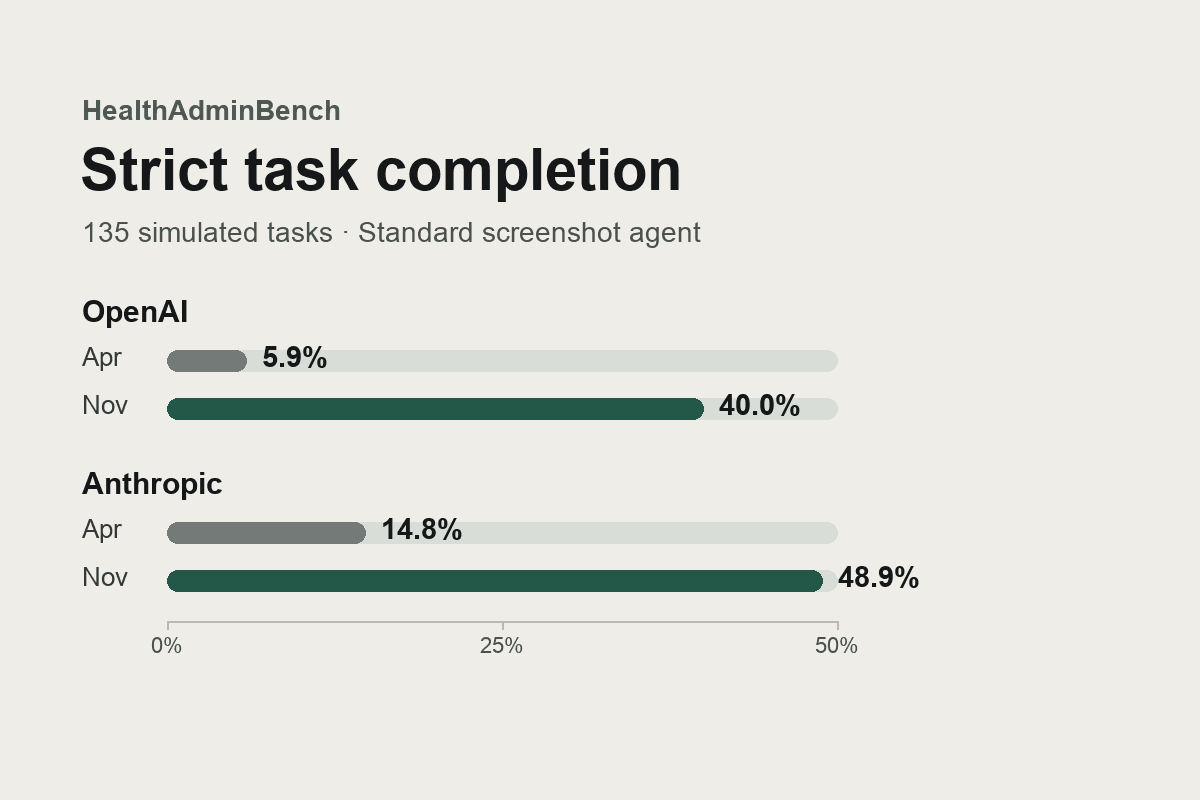
In April 2026, GPT-5.4 completed 8 of 135 simulated healthcare administration tasks and Claude Opus 4.6 completed 20. Seven months later, GPT-6.2 Sol completed 54 (40.0%) and Claude Opus 5.5 completed 66 (48.9%) in the same screenshot-and-portal-guidance setting. Both model families gained 46 completed tasks, or 34.1 percentage points, under strict scoring.
The smaller models also beat their families’ April results. Claude Haiku 5.5 completed 53 tasks (39.3%) and GPT-6 Luna completed 38 (28.1%). They cost about 95% and 90% less to run than Opus and Sol, respectively. The gains showed up across all three workflows and persisted when we looked only at checks that require no language-model judgment.
Strict scoring also left a wide gap between checks passed and tasks completed. When we reviewed every failed Sol and Opus run, 18% contained a clear agent error and 50% failed only on scoring behavior or unstated requirements. Changes to the harness, portals, and judge limit how much of the improvement we can attribute to the models themselves.
Download the original paper (PDF)
How task completion changed from April to November
A prior authorization can require reading an order in an electronic health record (EHR), submitting a request in a payer portal, and copying the confirmation back to the chart. Bedi et al. built HealthAdminBench around work like this, with 135 simulated tasks covering prior authorization, appeals and denials, and durable medical equipment. Under strict scoring, a task passes only when the agent satisfies every check. [1]
We compared the April study’s screenshot results with our November runs. Both evaluations gave agents the task description and general portal guidance. April tested two ways to operate the interface, while November used the benchmark’s standard screenshot agent.
Table 1. Strict task completion out of 135.
| Evaluation and agent configuration | OpenAI | Anthropic |
|---|---|---|
| April, standard screenshot agent | 8 (5.9%) | 20 (14.8%) |
| April, vendor-native computer-use loop | 36 (26.7%) | 49 (36.3%) |
| November, standard screenshot agent | 54 (40.0%) | 66 (48.9%) |
| Gain over April standard | +46 (+34.1 pp) | +46 (+34.1 pp) |
| Gain over April native | +18 (+13.3 pp) | +17 (+12.6 pp) |
The standard-agent rows give the closest comparison within each model family. The April paper’s headline result, 36.3%, came from Opus 4.6 using Anthropic’s computer-use tool. Both November models exceeded that result using the standard screenshot agent. The original study also tested other inputs and prompts. [1]
Where the gains appeared
Both model families completed more tasks in every workflow. Prior authorization accounted for 26 of OpenAI’s 46 additional completions and 19 of Anthropic’s. Opus made its biggest percentage-point gain in durable medical equipment, going from zero passes to 12 out of 15. Appeals and denials remained the hardest workflow for both November models, with Sol completing 13 of 60 tasks and Opus completing 25.
Table 2. Strict passes by workflow with the standard screenshot agent. April counts come from the released per-run records and reproduce the original paper’s Table 3. [1, 2]
| Workflow | Tasks | GPT-5.4 | GPT-6.2 Sol | Opus 4.6 | Opus 5.5 |
|---|---|---|---|---|---|
| Prior authorization | 60 | 4 | 30 | 10 | 29 |
| Appeals and denials | 60 | 2 | 13 | 10 | 25 |
| Durable medical equipment | 15 | 2 | 11 | 0 | 12 |
One task, emr-hard-3, had the same definition in both runs. The agent had to read a biologic dosing regimen, calculate six months of billing units, submit the request to the payer, record the authorization number in the EHR, and clear the referral. The benchmark expected 26 units. GPT-5.4 passed 3 of the 24 checks and Opus 4.6 passed 6. Both newer models passed all 24, including the calculation and the writes in both simulated systems. [2, 3]
What the deterministic checks showed
We isolated the 96 tasks with identical definitions across both evaluations and compared checks that look directly at recorded actions and portal state. The April export reports a combined total for deterministic checks and text rubrics. When the total passed is below the number of deterministic checks, the agent must have failed at least one deterministic check. Counting every remaining April task as a deterministic pass gives a generous upper bound.
GPT-5.4 could have passed every deterministic check on at most 30 of the 96 tasks, compared with 63 observed for Sol. Opus 4.6 could have done so on at most 39, compared with 53 observed for Opus 5.5. This comparison bypasses both text judges. Portal and harness versions still differ.
Why passing most checks still left so many failed tasks
Sol passed 91.3% of individual November checks and Opus passed 92.3%, pooled across tasks. Both completed fewer than half the tasks under strict scoring. We reviewed all 278 failed checks across the 150 failed Sol and Opus runs.
- 27 runs (18%) contained a clear agent error.
- 75 runs (50%) failed only on scoring behavior or unnecessary, unstated requirements.
- 48 runs (32%) had evidence that supported more than one judgment.
These percentages apply to failed November Sol and Opus runs. Three examples show what went into the review.
Clear agent error. In denial-easy-6, both agents reported finding no authorization. Neither opened the patient-name link, which led to a record showing an authorization that had expired ten days before service. That difference matters for staff deciding whether to ask a payer to honor an expired authorization.
Unstated requirement. In denial-medium-2, Sol appealed the two denied claim lines, distinguished them from the two paid lines, and documented the confirmation. The note failed three checks because it omitted the denied amount, a diagnosis code, and the appeal deadline. The task specified what to put in the note and left those details out.
Debatable decision. In denial-hard-8, the claim and member identifiers matched across the payer portal and EHR, while the date of birth, provider, and facility differed. Sol held the upload and documented the conflict. Opus filed the appeal and flagged it. The task called for an appeal and gave no rule for resolving the discrepancy. Four checks failed for Sol as a consequence of that one decision.
Table 3. How review judgments change November completion. Every row scores the same 135 recorded runs per model. The historical comparisons use upstream strict scoring.
| Scoring rule | GPT-6.2 Sol | Opus 5.5 |
|---|---|---|
| Upstream strict | 54 (40.0%) | 66 (48.9%) |
| Excuse hidden interface behavior, answer-key errors, and judge errors | 66 (48.9%) | 81 (60.0%) |
| Also excuse unnecessary, unstated requirements | 100 (74.1%) | 95 (70.4%) |
| Also accept every debatable decision | 124 (91.9%) | 119 (88.1%) |
Opus leads under strict scoring. Sol leads 100 to 95 once unnecessary, unstated requirements are excused. Looser rules can also obscure real failures. In emr-hard-16, Sol saved the authorization number and read a disabled button as confirmation that the referral had cleared. The referral was still in the queue. Requiring actual clearance wherever that check failed brings the third row down to 92 Sol passes and 88 Opus passes. We use the original strict scores for every comparison across generations.
How the smaller models compared on performance and cost
We ran Claude Haiku 5.5 and GPT-6 Luna once on each v3 task using the same harness, settings, and judge as the larger models. Their list prices per token were about one-fortieth of Opus 5.5’s and one-twentieth of Sol’s, respectively.
Table 4. Four November agents on the same 135 v3 tasks, one run per task. Costs use list API prices for agent calls and exclude the judge. Deterministic passes reflect recorded actions and portal state.
| Metric | GPT-6.2 Sol | GPT-6 Luna | Opus 5.5 | Haiku 5.5 |
|---|---|---|---|---|
| Strict completions | 54 (40.0%) | 38 (28.1%) | 66 (48.9%) | 53 (39.3%) |
| Prior authorization (60) | 30 | 24 | 29 | 27 |
| Appeals and denials (60) | 13 | 9 | 25 | 15 |
| Durable medical equipment (15) | 11 | 5 | 12 | 11 |
| Passed every deterministic check | 94 | 75 | 85 | 81 |
| Individual checks passed | 91.3% | 79.9% | 92.3% | 83.1% |
| Text rubrics passed | 82.2% | 64.6% | 87.6% | 74.9% |
| Agent cost, all 135 tasks | $87.17 | $8.51 | $149.18 | $6.91 |
| Cost per task | $0.65 | $0.06 | $1.11 | $0.05 |
Haiku finished one task behind Sol and four ahead of the April headline result. Against Opus 4.6 with Anthropic’s native tool, Haiku matched the appeals and equipment totals and completed 27 prior authorizations to the April agent’s 23. Opus 5.5 completed 13 more tasks than Haiku, with most of the difference in appeals and denials. On matched tasks, 32 passed only on Opus and 19 only on Haiku (exact McNemar p = 0.09). Haiku cost $0.05 per task in agent calls, compared with $1.11 for Opus.
Luna finished behind the other three November agents. It completed 16 fewer tasks than Sol (29 passed only on Sol, 13 only on Luna, p = 0.02) and 15 fewer than Haiku (p = 0.004). Its 38 completions still exceeded both April GPT-5.4 results, which were 8 with the standard agent and 36 with OpenAI’s native loop. Luna took 6,711 steps, the most of the four models. Ten runs hit the step limit, including nine on easy tasks.
Luna graded its own writing. GPT-6 Luna served as the November judge, so it graded the notes and appeal text it generated as an agent. Language-model judges can favor writing that resembles their own. Luna passed 64.6% of text rubrics and ranked last on both text and deterministic checks. Those results show no visible scoring lift. A low pass rate could still coexist with bias if it offset weaker writing. Testing for that would require regrading the same outputs with another judge. The failure review covered Sol and Opus only.
How we ran the comparison
April data. We used Bedi et al.’s April 10, 2026 paper and the maintainers’ per-task v2 export at revision b88844c8c3e4. The export includes a variant that removes selected process checks. We used the original columns with all checks retained, selected screenshot-only observations with general portal guidance, and matched runs by task ID. The April standard agents used GPT-5.4 and Claude Opus 4.6. The native configurations used the vendors’ own computer-use loops, which show how much the action interface can affect a model’s score. [1, 2]
November runs. On November 19, 2026, we ran GPT-6.2 Sol and Claude Opus 5.5 once on each v3 task with the released portals and standard agent classes. Adapters called the vendor APIs. Agents received screenshots, a goal, and general portal guidance, and acted using screen coordinates. Task-specific walkthroughs and scoring criteria were withheld. We ran GPT-6 Luna and Claude Haiku 5.5 the same way on November 21. The v3 tasks contained 1,177 deterministic checks and 517 text rubrics, for 1,694 checks total. The November judge, openai/gpt-6-luna, voted three times per rubric. April used GPT-5.4 as judge and had 1,698 checks. [1, 3]
Failure review. Claude and Codex reviewed failed checks against task goals, supplied guidance, recorded actions, saved portal state, grader evidence, and relevant source code. They wrote a rationale for each failure. Consequences inherited the judgment on the underlying decision, such as a missing confirmation after a withheld appeal. Any independent clear error put the run in the agent-error group. Reviewers could see model identities and scores. The review excluded passing runs and had no independent billing-specialist adjudication or inter-rater agreement measurement.
What the results can tell us
The benchmark moved from v2 to v3 between April and November. On the 96 tasks whose definitions stayed identical, GPT went from 6 to 44 strict completions and Opus went from 13 to 43. Those gains suggest changes to task definitions alone explain little of the improvement. The gains also persisted on deterministic checks. The model, harness, and portal releases changed together, so these runs cannot isolate the effect of the model update. The tasks were public during the interval, and any prior exposure is unknown. One attempt per task leaves run-to-run variance unmeasured. The same limits apply to both smaller models, with the additional judge caveat for Luna’s text scores.
A model-only comparison would rerun both generations in the same frozen environment with a common judge. Measuring value in a clinic would also require repeatability, appropriate escalation, and confirmation that requested changes reached the patient record.
Reproducing the results
The paper describes a source archive with the per-task comparison extract, scripts to reproduce the tables, and 540 November task records. It includes check-level review judgments for the 270 Sol and Opus runs. The comparison script can rebuild its extract from the pinned upstream checkout and the November per-task statistics.
References
- S. Bedi, R. Welch, E. Steinberg, et al. HealthAdminBench: Evaluating Computer-Use Agents on Healthcare Administration Tasks. April 2026, Figure 3 and Table 3. arXiv:2604.09937
- Shah Lab. Per-run v2 scores, original and process-check variants, revision
b88844c8c3e4. Per-run export - Shah Lab. HealthAdminBench source, task definitions, and harness at the same revision. Pinned repository