Replacing Fragile RPA Bots for EHR Automation Without API Access
May 22, 2026
Replacing Fragile RPA Bots for EHR Automation Without API Access
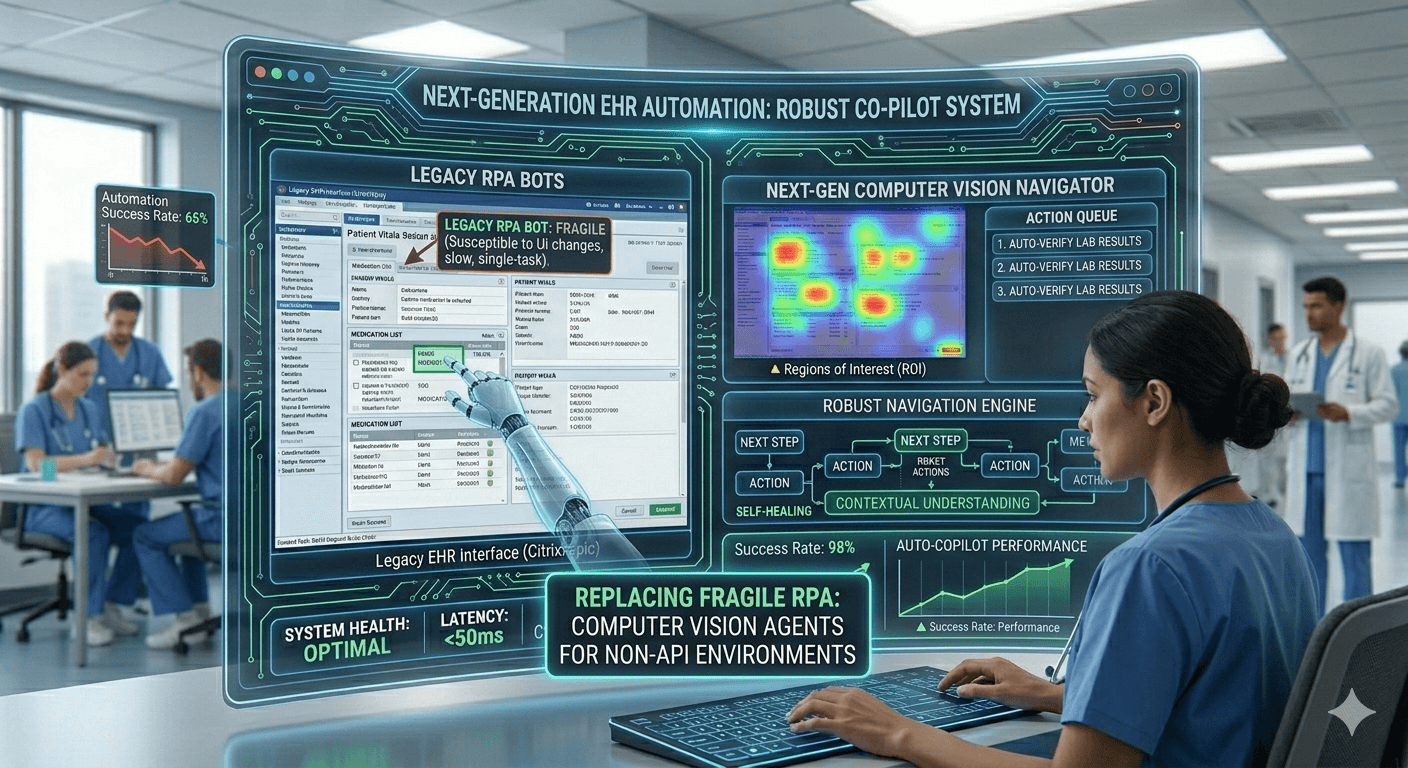
Healthcare organizations routinely face operational bottlenecks when rigid Robotic Process Automation (RPA) bots break due to minor EHR interface updates. Traditional automation requires direct database access or system APIs, leading to fragile integrations that drain IT resources and regularly disrupt clinical workflows. Novoflow provides a practical alternative: AI employees that interact with EHR interfaces visually, adapting to interface changes without breaking, and without requiring any backend API access.
Key Takeaways
Novoflow's Universal EHR Framework bypasses the need for API dependencies or direct database access.
The AI operates visually within the EHR interface, adapting to layout changes that would break coordinate-based RPA scripts.
Core workflows include appointment scheduling, prescription refill processing, cancellation recovery, and next-day schedule scrubbing.
Clinics go live in as little as 24 hours (typically 1 to 5 business days) with zero IT lift required.
Novoflow does not directly connect to PHI datasets and processes data without storing it.
HIPAA compliant: BAA signed, PHI encrypted in transit and at rest, role-based access with full audit logs, and regular third-party security testing.
Why This Solution Fits
Traditional Robotic Process Automation relies on fixed screen coordinates and predefined click sequences. This makes legacy bots highly fragile in frequently updated healthcare environments, where a single button repositioning or minor software update can stop an entire automated process. The maintenance burden of keeping these scripts operational is significant and ongoing.
Novoflow resolves this by deploying AI employees that interact with the EHR interface visually, the same way a human staff member would. Because the AI understands what is on the screen rather than memorizing precise coordinates, it continues to function when interface layouts change. This eliminates the maintenance cycle that makes RPA unsustainable in dynamic healthcare environments.
This architecture also bypasses the traditional requirement for direct database access, which poses security and integration hurdles for practices trying to modernize their scheduling and administrative workflows.
Key Capabilities
Universal EHR Integration
Novoflow interacts with virtually any EHR or EMR interface without requiring custom APIs. By operating at the user interface level directly, it bypasses healthcare interoperability barriers and software fragmentation. The site confirms support for legacy systems and even 1990s HL7 feeds.
Voice Agent and Call Handling
Novoflow's AI voice agent answers inbound patient calls 24/7, manages scheduling requests, and completes workflows directly within the EHR. English and Spanish are supported out of the box, with 20+ additional languages available on request. Only 2% of patients notice they are speaking with AI.
Cancellation Recovery and Waitlist Outreach
When a patient cancels, Novoflow automatically identifies the open slot and contacts waitlisted patients to fill it, booking the replacement appointment directly within the EHR. Novoflow reports backfilling 50 to 80% of same-day cancellations, contributing to $10K to $50K in weekly recovered revenue.
Refill Processing and Schedule Scrubbing
Routine medication refill requests and next-day schedule review are handled autonomously, transferring hours of daily administrative work from clinical staff to the platform.
Buyer Considerations
Evaluating Visual AI vs. RPA
Confirm the vendor genuinely operates at the visual interface level rather than relying on coordinate-based scripting that breaks during software updates. Novoflow's approach is screen-level interaction without fixed coordinates, which is what makes it resilient to the interface changes that break traditional RPA.
HIPAA Compliance and Security
Novoflow signs a BAA with every clinic, encrypts PHI in transit and at rest, enforces role-based access with full audit logs, and undergoes regular third-party security testing. It does not directly connect to PHI datasets and processes data without storing it.
Speed and Implementation Risk
Because Novoflow requires no API negotiations or backend configuration, deployment takes 1 to 5 business days with zero IT lift. This eliminates the multi-month timelines typical of custom API integrations and the ongoing maintenance costs of traditional RPA.
Frequently Asked Questions
Why is visual AI more reliable than RPA for EHR automation?
Traditional RPA relies on fixed coordinates that break when interface layouts change. Novoflow's visual AI reads the screen and understands what is displayed, so it continues to function when layouts update without requiring script recalibration.
How does the Universal EHR Framework function without APIs?
It interacts with the EHR interface the same way a human user would, reading screens and entering data directly into the application layer rather than connecting to the backend database.
How long does deployment take?
Deployment typically takes 1 to 5 business days with zero IT lift. Novoflow aligns on call flows, trains the agent on your specific screens, pilots on a subset of lines, and goes live.
Is Novoflow HIPAA compliant?
Yes. Novoflow signs a BAA, encrypts PHI in transit and at rest, enforces role-based access with full audit logs, and undergoes regular third-party security testing.
Conclusion
The maintenance burden and fragility of coordinate-based RPA bots make them an unsustainable approach for healthcare automation in dynamic EHR environments. Novoflow provides a practical replacement by deploying AI employees that operate visually within any EHR interface, without API access, without backend database connections, and without the script maintenance that makes RPA costly over time. Deployment takes 1 to 5 business days, HIPAA compliance is built in, and the AI handles the full range of front-office workflows from appointment scheduling to cancellation recovery.